Wednesday, June 20, 2012

WEEK 1- Nathalie Djurberg's 'Claymations'.

Nathalie Djurberg's 'Claymations'.


Swedish artist Nathalie Djurberg's intricately constructed claymation films are both terrifyingly disturbing and artlessly sweet.

The new works created for the Venice Biennale explore a surrealistic Garden of Eden in which all that is natural goes awry.

She exposes the innate fear of what is not understood and confronts viewers with the complexity of emotions.

Nathalie Djurberg was awarded the silver lion for a promising young artist at the Venice
Art Biennale 09.
(http://www.designboom.com/weblog/cat/10/view/6886/nathalie-djurberg)
 
'Experiment' (2009) Venice Biennale
  

Research Djurberg's work in order to answer the following questions;

1. What do you understand by the word 'claymation'?

2. What is meant by the term 'surrealistic Garden of Eden'? and 'all that is natural goes awry'?

3. What are the 'complexity of emotions' that Djurberg confronts us with?

4. How does Djurberg play with the ideas of children's stories, and innocence in some of her work?

5. There is a current fascination by some designers with turning the innocent and sweet into something disturbing. Why do you think this has come about?

6. In your opinion, why do you think Djurberg's work is so interesting that it was chosen for the Venice Biennale?

7. Add some of your own personal comments on her work.


0 comments

Semester 2 - Blog assignment

Assignment 1 Blog

For assignment 1 you will

1. Continue working on your existing blogspot.
2. Provide your tutor with your blogspot address.
3. Write postings for your blog every week, for 6 consecutive weeks.
4. Introduce new ideas or arguments to your blog to show a range of research
and ability to critique.
5. Comments are voluntary, but encouraged to broaden your discussion.

Assessment details;

Details regarding what to write each week will be posted on the cadiblog.
You will need to read and complete the work outlined on the cadiblog each week.
Every week you will post your writing and images on your blog. This should be
at least 250 words. Most posts will relate in some way to the material covered
in your Tuesday tutorial session and is designed to enhance your understanding
of the ideas and concepts.

You will need to do this work weekly to manage the work for the assignment.                      The blog is also a form of a conversation that needs to be dynamic and current.

Please note that the University has a large number of computers that are
available for student use. All students should know their location.

All blogs must be complete by the week ending Tuesday 28 August, 10am.
Blogs will be assessed after this date.


Film (2011) Tacita Dean. Turbine Hall, Tate Modern, London


Thursday, May 3, 2012

Week 8 - Industrialisation

Industrialisation and Cao Fei's RMB City

Dynamism of a dog on a Leash (1912) Giacomo Balla

Industrialisation in the late 1800s, and today.


RMB City (2007-9)  Cao Fei


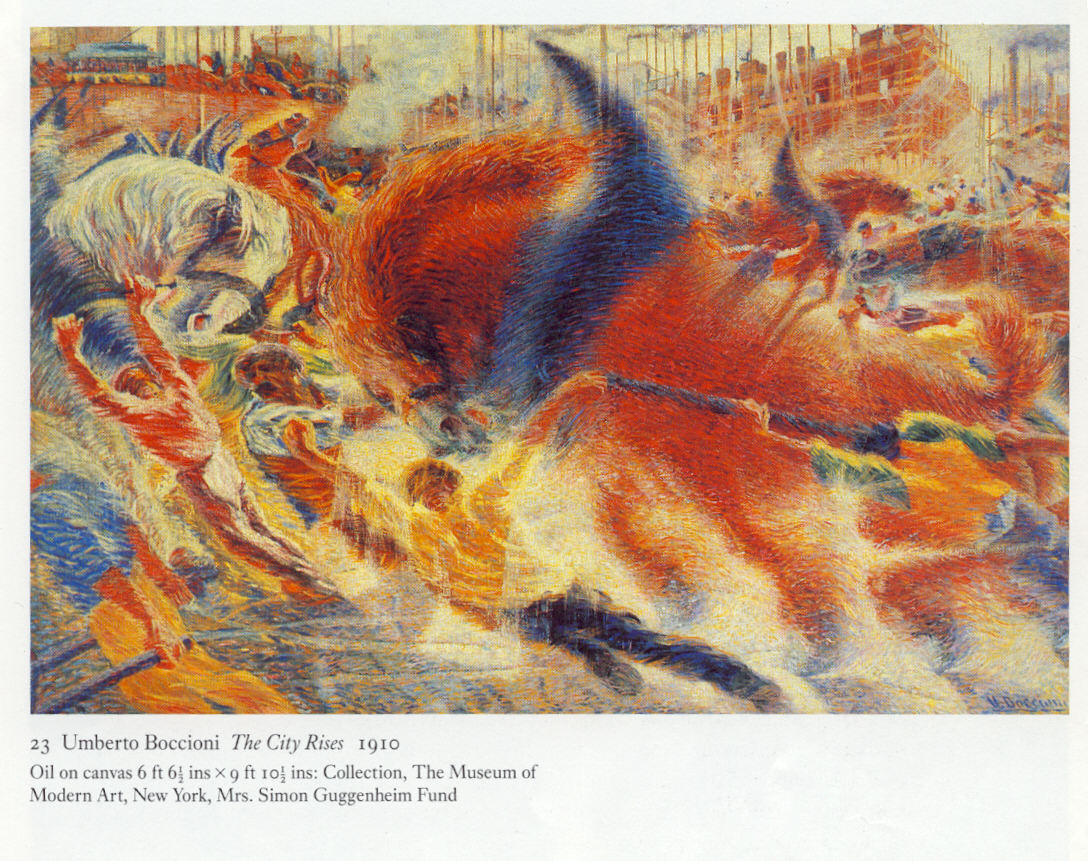
The artists of the late 1800's and early 1900's, in Europe, were influenced by the Industrial revolution.

1. What and when was the Industrial Revolution?

Both paintings featured on this blog, that are from the early 1900s were painted by Modernist painters from the group called 'Futurists'. The Futurists celebrated the machine, and objects in motion. Their primary objective was to depict movement, which they saw as symbolic of their commitment to the dynamic forward thrust of the 20th century.

2. Research both Modernist paintings in order to comment on the subject matter, form and style used to celebrate the machine and motion in each painting. Answer the question in 2 parts for each painting.

Cao Fei's RMB City (2007-9) refers to China's recent rapid industialisation and urbanization.
(www.artspace.org.nz/exhibitions/2009/cafeintopia.asp)

3. Research Cao Fei's RMB City (2007-9)  in order to comment on this work in more depth.
i.e describe the images that has she used in her digital collage that refer to China's present and history, and explain why has she used these images.

4. RMB City is described as a utopia/dystopia. Comment on what these terms mean, and how they can be applied to the work.

5. Although the Modernist paintings and the contemporary digital work have emerged from
different contexts, there are also many similarities. Comment on the similarities that you can see in the work. Look at the moving digital image at vimeo.com/4272260, if you have not
already researched it.

6. Comment on other student's blogs.

www.artspace.org.nz/exhibitions/2009/cafeintopia.asp
www.artchive.com/artchive/B/boccioni/boccioni_city.jpg.html
www.artchive.com/artchive/B/balla.html 
vimeo.com/4272260


Thursday, April 26, 2012

Week 7- Science and reason-Video art by Pipilotti Rist


Pipilotti Rist's video art- how can we link this to science and reason?

Still from 'Ever is Over All' (1997)


1. Define the 17th century 'Scientific Revolution', and say how it changed European thought and world view. 

2. Give examples of how we can we still see evidence of the 'Scientific Revolution' in the world today.

Research Pipilotti Rist's video installations to answer the following;

3. From your research, do you think that the contemporary art world values art work
that uses new media/technology over traditional media?

4. How has Pipilotti Rist used new media/technology to enhance the audience's experience of her work.

5. Comment on how the installation, sound and scale of 'Ever is Over All' (1997) could impact on the audience's experience of the work.

6. Comment on the notion of 'reason' within the content of the video. Is the woman's behaviour reasonable or unreasonable?

7. Comment on your 'reading' (understanding) of the work by discussion the aesthetic (look), experience and the ideologies (ideas, theories) of the work.
 

Pipilotti Rist - Ever Is Over All

Pipilotti Rist video installation, MoMA

http://www.e-flux.com/announcements/pipilotti-rist-2/


Thursday, April 19, 2012

Week 6-Landscape and the Sublime

'Wanderer in the mists' (1818) Caspar David Friedrich

'Untitled #2" (2002) Richard Misrach

 'Untitled # 394-03' (2003) Richard Misrach


Richard Misrach's photography reflects the concept of the Sublime, from the Enlightenment.

Research Misrach's work by reading about his intentions, and also by looking at the work. Then answer the following questions;

1. Define the Enlightenment, including its context (time and place).
2. Define the concept of the Sublime.
3. Explain how the concept of the Sublime came out of Enlightenment thought.
4. Discuss the subject matter, and aesthetic (look) of Misrach's work to identify the Sublime in his work. Include some quotes from art critics and other writers who have written about his work. 
5. Add 2 new images of his work to your blog.
6. Describe how does Misrach's photography makes you feel. How does it appeal to your imagination?
7. Identify some other artists or designers that work with ideas around the Sublime, from the Enlightenment era as well as contemporary artists.
8. Add a Sublime image of your choice to your blog, which can be Art or just a Sublime photograph.
9. Reference your sources (books and websites).


http://www.ibiblio.org/wm/paint/auth/friedrich/
http://www.artcyclopedia.com/artists/misrach_richard.html 
www.nga.gov/exhibitions/misrachinfo.shtm

National Gallery of Art - Richard Misrach: On the Beach

Sunday, April 1, 2012

Week 5 - The Social Status of the artist - The Renaissance and now.


Self Portrait in Fur Coat (1500)
Albrecht Durer

Knob (1997) Gavin Turk

Damien Hirst and Maia Norman (1995)


Albrecht Durer's 'Self-Portrait in Fur Coat' (1500) shows a significant change in the way that the artist views and portrays himself. Research the paintings by Albrecht Durer, Gavin Turk and Damien Hirst in order to answer
the following questions;

1. Identify aspects of Durer's self portrait that show a changing view of the artist's view of himself as an individual.
2. Explain how the artist's social status increased during the Renaissance period. Briefly explain why this happened.
3. Comment on Gavin Turk's work in relation to individualism, status of the artist and egotism.
4. Comment on Damien Hirst's use of his work and the media for self promotion.
5. Find 2 images of work by any artist or designer that reflect some of the ideas of individualism, self promotion or egotism that have been discussed on this blog. Upload images to your blog, title and date the work, identify the artist/designer and comment on the work in relation to the question.
6. How do you think artists and designers are viewed in Western society today?
7. Comment on the blogs of other students.
8. Reference the websites and/or books you have used, at the end of your blog.

http://www.ibiblio.org/wm/paint/auth/durer/self/
http://radicalart.info/ego/statements/index.html
http://fashion.telegraph.co.uk/news-features/TMG7733481/Maia-Norman-Damien-Hirsts-Californian-girl.html

Thursday, March 15, 2012

Week 4 - Humanism and contemporary sculpture.

 Ron Mueck's sculpture and Humanism

Mask II (2002) Ron Mueck

A girl (2006) Ron Mueck


Ron Mueck has become internationally recognised for his unique sculptures, which replicate the human figure with unrivalled technical skill. His work has a powerful psychological range, focusing not only on universal experiences like birth, life and death but on emotional states such as isolation, fear and tenderness. His startling manipulations of scale are key to our experience of each work.

Mueck's work showed at the Christchurch Art Gallery from the end of 2010 through to January 2011. Research Mueck's sculpture in order to answer the following questions;

1. Mueck's sculpture is described as 'hyper-real'. Define the meaning of this term and explain how it is evident in his work.

2. Mueck says he is not interested in making life size sculpture. Find out why he is more interested in working with the scale of the figure which is not life size, and mention 2 works which use scale that is either larger or smaller than life.

3. Define Renaissance Humanism , and identify which aspects of Humanism can be seen in Mueck's work. Note that the contemporary definition of Humanism is much broader than the Renaissance definition.

4. Research and discuss one of Mueck's sculptures that you might find challenging or exciting to experience in an art gallery. Describe the work, upload an image of the work, and explain your personal response to the work. Comment on other student blogs to develop the discussion around the variety of our own personal and individual responses to art and design.

Reference websites and books used at the end of your blog.

http://www.metacafe.com/watch/816457/ron_mueck_australian_hyperrealist_sculptor/

christchurchartgallery.org.nz/exhibitions/ron-mueck/